

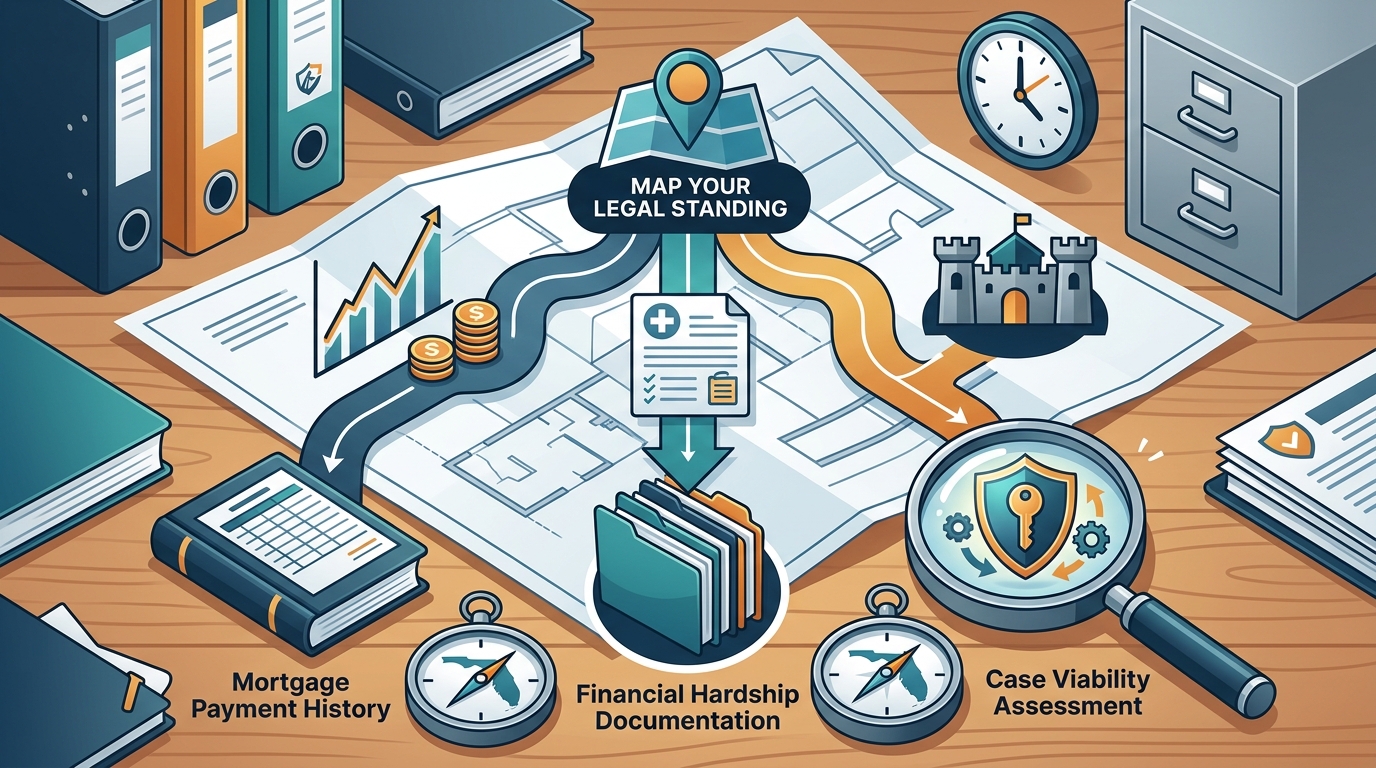
A free foreclosure consultation reveals your exact payment history, the specific financial hardship causing your delinquency, and a clear assessment of whether your case is viable for loss mitigation. Foreclosure Guard in Tampa, Florida, uses this confidential intake process to map your legal standing and identify the fastest path to protect your home. This guide details the three core areas of analysis: mortgage payment history, financial hardship documentation, and case viability assessment.
Mortgage Payment History Analysis
The first layer of a confidential consultation involves a deep dive into your mortgage payment history. This is not just about knowing how many payments you missed. It is about understanding the timeline of your delinquency relative to federal and state regulations. Foreclosure Guard reviews your account to determine where you stand in the judicial process.
The 120-Day Federal Rule
Under federal regulations, a mortgage servicer generally cannot file the first foreclosure lawsuit until you are more than 120 days behind on payments. This rule provides a critical window of time for homeowners to seek help. During the consultation, we verify if your servicer has adhered to this timeline. If you are 90 days late, you are in a different legal position than if you are 150 days late. The former allows for early intervention, while the latter may indicate that a lawsuit is imminent or already filed.
Identifying the Stage of Foreclosure
Florida is a judicial foreclosure state, meaning the lender must file a lawsuit in circuit court to take your home. The consultation determines if you have received a default letter, a notice of acceleration, or actual court papers. If you have been served with a summons and complaint, you generally have 20 days to file a written response. Missing this deadline can lead to a default judgment. By analyzing your payment history and the documents you have received, we pinpoint exactly where you are in this timeline.
Surplus Funds and Equity
Payment history also helps determine your equity position. If your home sells at auction for more than the judgment amount, the extra money is called surplus funds. You may be entitled to claim this money through the court. Understanding your payment history allows us to estimate if you have positive equity that can be preserved through a sale or a modification.
Financial Hardship Details and Documentation
The second core component of the consultation is a detailed review of your financial hardship. Lenders require a specific narrative of why you cannot make your payments. This is not a judgment on your character. It is a factual assessment of your current financial capacity. Foreclosure Guard helps you articulate this hardship clearly and accurately.
Income and Expense Verification
We analyze your total monthly income against your living expenses. This includes your primary take-home pay, any second income, and benefits or assistance you receive. We then compare this to your monthly living costs, such as utilities, food, transportation, and insurance. The goal is to calculate your debt-to-income ratio and determine if your current housing payment is sustainable. If your housing payment exceeds 30% of your income, it is a strong indicator that a loan modification or forbearance might be necessary.
Documenting the Hardship Event
A valid hardship must be documented. Common examples include job loss, a significant reduction in hours, a medical emergency, or the death of a co-borrower. During the consultation, we help you gather the necessary proof. This might include pay stubs, termination letters, medical bills, or bank statements. The more specific and documented the hardship, the stronger your case for loss mitigation options like a repayment plan or a loan modification.
Temporary vs. Permanent Hardship
We distinguish between temporary and permanent hardships. A temporary hardship, such as a short-term medical issue, may qualify you for a forbearance agreement, which pauses payments for a set period. A permanent hardship, such as a long-term disability, may require a permanent change to your loan terms, such as a lower interest rate or an extended loan term. This distinction is critical for choosing the right strategy.
Case Viability Assessment and Options
The final and most critical part of the consultation is the case viability assessment. This is where we combine your payment history and hardship details to determine which options are actually available to you. Not every homeowner qualifies for every option. The viability assessment tells you what is realistic and what is not.
Reinstatement and Repayment Plans
Reinstatement involves paying everything you are behind on, plus fees, in one lump sum. This is only viable if you have the cash reserves to do so. A repayment plan allows you to catch up over several months by adding a portion of the arrears to your regular payment. This is viable if your income has stabilized and you can afford a slightly higher monthly payment. The consultation determines if you have the financial capacity for either of these options.
Loan Modification and Forbearance
A loan modification permanently changes your loan terms to make the payment more affordable. This is often the best option for homeowners who have a permanent hardship but want to keep their home. Forbearance is a temporary pause or reduction in payments. The viability of these options depends on your loan type, your equity, and how far along the foreclosure case is. We review your specific loan documents to see if you qualify.
Sale Strategies: Short Sale and Deed in Lieu
If keeping the home is not viable, we assess sale strategies. A short sale is selling the home for less than you owe, with your lender's approval. A deed in lieu of foreclosure is voluntarily giving the home back to the lender. These options can be less damaging to your credit than a completed foreclosure. The consultation helps you understand the credit impact of each path and how to protect your financial future.
| Option | Viability Criteria | Credit Impact | Best For |
|---|---|---|---|
| Reinstatement | Ability to pay all arrears in one lump sum | Minimal if done early | Homeowners with cash reserves |
| Repayment Plan | Stable income, ability to pay higher monthly amount | Moderate | Homeowners with temporary income dips |
| Loan Modification | Permanent hardship, sufficient equity | Moderate to Low | Homeowners who want to stay |
| Short Sale | Negative equity, lender approval | High, but less than foreclosure | Homeowners who must move |
| Deed in Lieu | Negative equity, no other options | High, but less than foreclosure | Homeowners with no equity |
Key Takeaways
- A free consultation reveals your exact position in the Florida judicial foreclosure timeline.
- The 120-day federal rule is a critical benchmark for determining if a lawsuit has been filed.
- Financial hardship must be documented with specific proof, such as pay stubs or medical bills.
- Case viability depends on your equity, income stability, and the type of loan you hold.
- Reinstatement and repayment plans are only viable if you have the cash flow to support them.
- Loan modifications are best for permanent hardships where you want to keep your home.
- Short sales and deeds in lieu are viable alternatives when keeping the home is not possible.
- Acting early preserves more options and limits the damage to your credit score.
Frequently Asked Questions
Is the consultation really free and confidential?
Yes. Foreclosure Guard offers a free, confidential phone consultation. We do not charge for the initial assessment, and we do not sell your personal information. The conversation is private and designed to help you understand your options without pressure.
What documents should I have ready for the call?
You should have your most recent mortgage statement, any letters from your servicer, and proof of income. If you have received court papers, have those ready as well. If you do not have all documents, we can still start the conversation and guide you on what to gather.
How long does the consultation take?
A typical consultation takes 30 to 45 minutes. We need enough time to review your payment history, discuss your hardship, and explain your options. We will not rush you, and we will not keep you on the phone longer than necessary.
Can I get help if I am not behind on payments yet?
Yes. If you are worried about falling behind, you can still call. Early intervention is the best way to prevent foreclosure. We can help you create a budget and identify potential issues before they become critical.
What if I have already been served with a lawsuit?
Call immediately. You generally have 20 days to respond to a foreclosure lawsuit in Florida. Missing this deadline can lead to a default judgment. We will help you understand your rights and the next steps you need to take.
Do you work with all types of loans?
We review conventional, FHA, and VA loans. The options available to you may vary depending on the loan type. We will explain the specific rules that apply to your mortgage during the consultation.
Is Foreclosure Guard a law firm?
No. Foreclosure Guard is not a law firm and does not give legal or tax advice. We provide guidance and help you understand your options. For legal advice, you should speak with a licensed Florida attorney. We can help you find free legal resources if needed.
Conclusion
Understanding the confidential details of your case is the first step toward protecting your home. By analyzing your mortgage payment history, documenting your financial hardship, and assessing your case viability, you gain the clarity needed to make informed decisions. Foreclosure Guard is here to help you navigate this process with confidence and without judgment. If you are facing foreclosure in Tampa or anywhere in Florida, take the first step today. Request your free consultation and let us help you find the right path forward.