

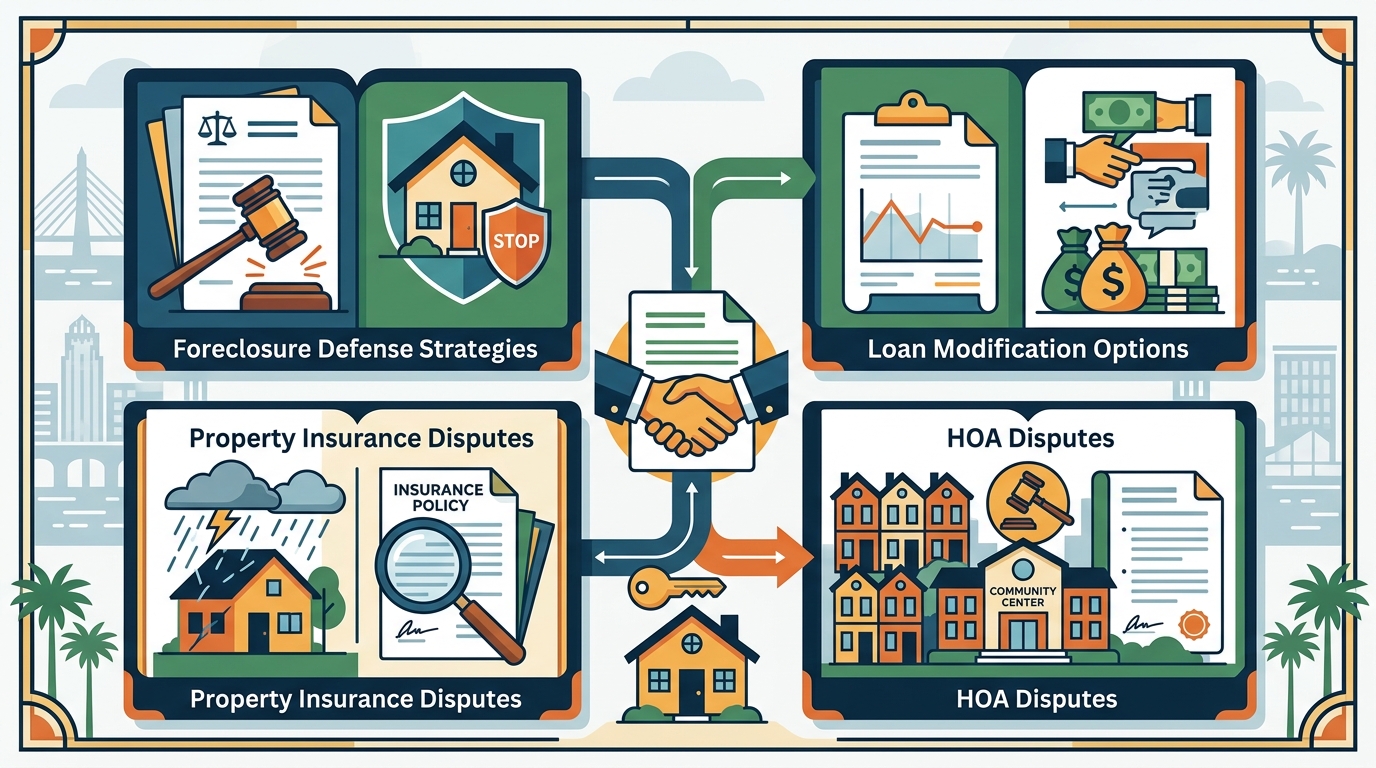
Foreclosure Guard provides a free, confidential consultation to help Tampa homeowners understand their legal options. This guide covers four critical areas: foreclosure defense strategies, loan modification options, property insurance disputes, and HOA disputes. We explain how a free assessment can clarify your path forward and protect your property rights in Florida.
Foreclosure Defense Strategies
Florida uses a judicial foreclosure process, meaning your lender must file a lawsuit in circuit court before selling your home. This legal requirement provides a critical window of time for homeowners to act. Foreclosure defense is the legal process of challenging a lender's claim or negotiating terms to stop the sale of your property. During a free consultation, we review your specific case to identify viable defenses.
Understanding the Judicial Process
When a lender files a foreclosure lawsuit, you are served with a summons and complaint. You generally have 20 days to file a written response with the court. Missing this deadline can result in a default judgment, which is often difficult to overturn. We help you understand these deadlines and the implications of each stage. Acting early is essential because options narrow significantly once a final judgment is entered and a sale date is set.
Common Legal Defenses
Several defenses may apply depending on your loan documents and the lender's actions. These include challenging improper notice, errors in the chain of title, or violations of federal servicing rules. We review your mortgage documents and correspondence to see if any procedural errors exist. If a defense is viable, we can help you prepare the necessary documentation for the court.
Mediation and Case Management
Many Florida courts offer foreclosure mediation or case management programs. These programs provide a structured environment for you and your lender to negotiate a resolution. Participation can sometimes lead to a loan modification or repayment plan that avoids a sale. We can explain how these programs work and help you prepare for the mediation session.
Loan Modification Options
A loan modification is a permanent change to the terms of your mortgage to make the payment more affordable. This is often the most effective way to keep your home if you have a long-term income issue. During a free consultation, we assess whether your financial situation qualifies for a modification and help you prepare the application.
Types of Modifications
Lenders may offer several types of modifications, including interest rate reductions, term extensions, or principal forbearance. Each option has different implications for your credit and long-term costs. We explain how each type works and which one might fit your budget. It is important to understand that a modification is a negotiation, and the lender is not always required to approve it.
The Application Process
Applying for a loan modification requires submitting a loss mitigation application with detailed financial information. This includes proof of income, bank statements, and a hardship letter. We help you organize these documents and ensure your application is complete. A complete application triggers federal protections that prevent the lender from filing for foreclosure while they review your request.
Reinstatement and Repayment Plans
If you are only temporarily behind, a reinstatement or repayment plan may be a better option than a modification. Reinstatement involves paying all past-due amounts in one lump sum to bring the loan current. A repayment plan allows you to catch up on missed payments over several months. We help you determine which short-term solution best fits your financial recovery plan.
Property Insurance Disputes
Property insurance disputes can complicate foreclosure proceedings, especially if your home is damaged or your coverage is contested. A property insurance dispute is a disagreement between a homeowner and their insurer over the terms, coverage, or payout of a policy. These disputes can affect your ability to maintain the property or qualify for certain loan modifications.
Impact on Foreclosure
If your home suffers damage and your insurance claim is denied or delayed, you may fall behind on your mortgage while trying to pay for repairs. This can accelerate the foreclosure process. We help you understand how insurance disputes interact with your mortgage obligations. In some cases, resolving the insurance issue is a prerequisite for the lender to consider a loan modification.
Documenting Your Case
Building a strong case for your insurance claim requires thorough documentation. This includes photos of the damage, repair estimates, and a detailed timeline of events. We help you organize this information and understand your rights under your policy. If the dispute becomes legal, we can refer you to a licensed attorney who specializes in insurance law.
HOA Disputes
Homeowners Association (HOA) disputes can create additional financial burdens that contribute to foreclosure. An HOA dispute is a conflict between a homeowner and their association over fees, rules, or liens. In Florida, HOAs can place liens on your property for unpaid dues, which can complicate your title and make it harder to sell or refinance.
HOA Liens and Foreclosure
If you fall behind on HOA dues, the association may file a lien against your property. This lien must be paid off when the home is sold, even in a foreclosure auction. We help you understand the impact of HOA liens on your foreclosure case. In some cases, negotiating with the HOA to remove or reduce the lien can be a key step in resolving your mortgage issues.
Negotiating with Your HOA
Many HOAs are willing to work with homeowners who are facing financial hardship. We can help you communicate your situation to the HOA and explore options for a payment plan or waiver of late fees. Resolving HOA disputes can improve your overall financial picture and make you a more attractive candidate for a loan modification.
Comparison of Legal Options
| Option | Best For | Impact on Credit | Timeframe |
|---|---|---|---|
| Foreclosure Defense | Homeowners with valid legal defenses | Varies by outcome | Months |
| Loan Modification | Long-term income issues | Can be less damaging than foreclosure | 3-6 months |
| Reinstatement | Temporary hardship with savings | Minimal if resolved quickly | Immediate |
| HOA Lien Resolution | Homeowners with HOA liens | Indirect | Weeks to months |
Key Takeaways
- Florida's judicial foreclosure process gives you time to act, but deadlines are strict.
- A free consultation can help you identify which legal options fit your specific situation.
- Loan modifications can permanently change your mortgage terms to make them affordable.
- Property insurance disputes can delay foreclosure resolution if not handled properly.
- HOA liens can complicate your title and must be addressed in any foreclosure case.
- Acting early preserves more options and can limit damage to your credit.
- Foreclosure Guard provides free, confidential guidance to help you make informed decisions.
Frequently Asked Questions
What is the first step in stopping a foreclosure in Tampa?
The first step is to contact your lender and request a loss mitigation application. You should also seek a free consultation with Foreclosure Guard to understand your legal options and deadlines.
How long does a foreclosure take in Florida?
Florida foreclosure is a judicial process that typically takes several months. The timeline depends on how quickly you respond to the lawsuit and whether you reach an agreement with your lender.
Can I keep my home if I am more than 120 days behind?
Yes, it is still possible to keep your home. Federal rules prevent lenders from filing for foreclosure until you are more than 120 days behind, but you may still qualify for a loan modification or other assistance after that point.
What documents do I need for a loan modification?
You will need proof of income, bank statements, tax returns, and a hardship letter. We can help you gather and organize these documents for your application.
Do HOA liens affect my ability to refinance?
Yes, HOA liens must be paid off before you can refinance or sell your home. Resolving these liens is an important part of any foreclosure defense strategy.
Is a free consultation really free?
Yes, Foreclosure Guard offers free, confidential consultations with no obligation. We will explain your options in plain language and help you decide on the best next step.
Conclusion
Facing foreclosure is stressful, but you have more options than you might think. Foreclosure Guard is here to help Tampa homeowners navigate the legal complexities of foreclosure, loan modifications, insurance disputes, and HOA issues. Our free, confidential consultation provides the clarity you need to make informed decisions about your home and financial future. We are not a law firm, but we can help you understand your options and connect you with the right resources.
To start your free consultation, contact Foreclosure Guard today. We are ready to listen and help you find a path forward.