

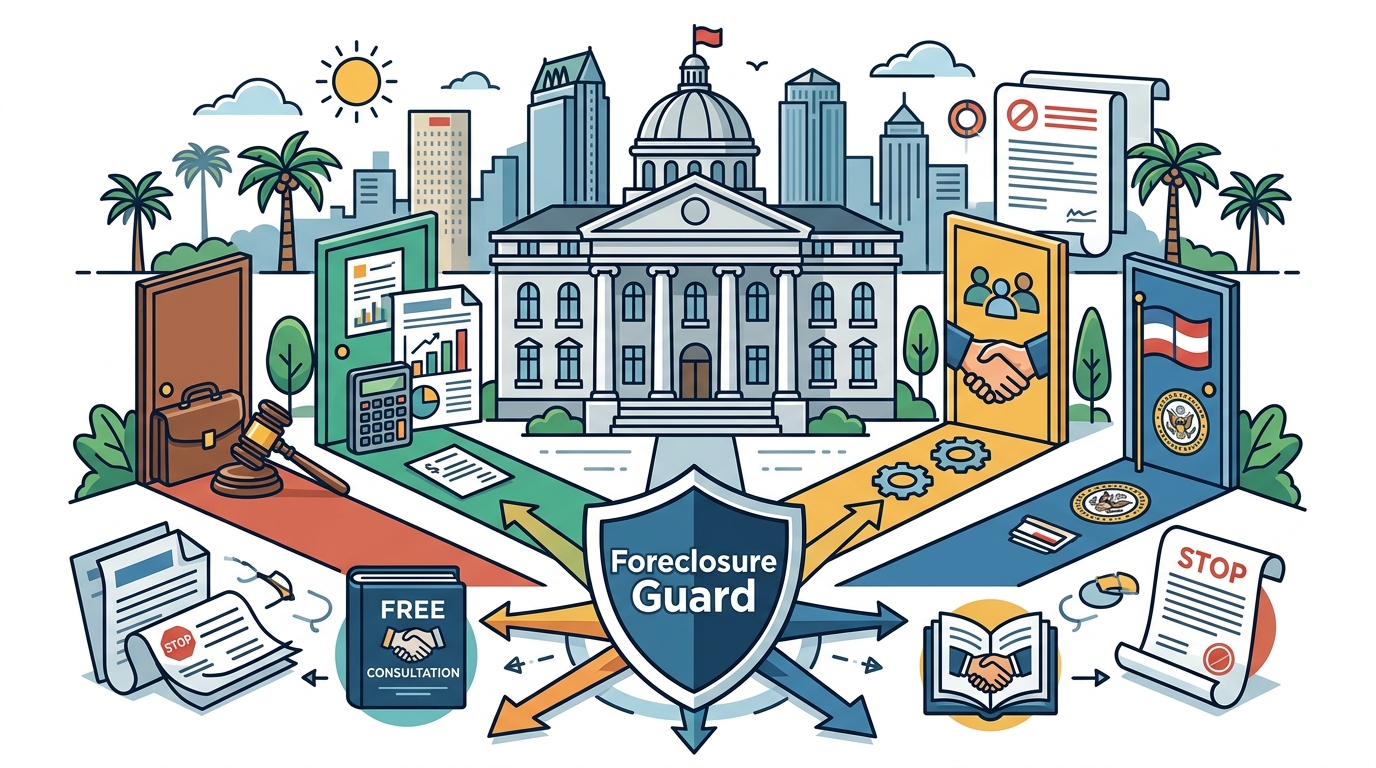
Choosing the right provider depends on your specific legal stage, financial capacity, and urgency. For immediate, confidential guidance on your options, Foreclosure Guard offers a free consultation to help you navigate the process. This guide compares the four primary types of assistance available in Tampa: private defense attorneys, loan modification negotiators, legal aid organizations, and government programs.
Foreclosure Defense Attorneys
Foreclosure defense attorneys are licensed legal professionals who represent homeowners in court to challenge the validity of a foreclosure lawsuit. In Florida, which is a judicial foreclosure state, the lender must file a lawsuit and obtain a judgment before selling the home. This legal process provides a window of time where an attorney can intervene. Attorneys are essential if you have been served with a summons and complaint, as you generally have only 20 days to file a written response with the court. Missing this deadline can result in a default judgment, which is often difficult to overturn.
When to Hire a Private Attorney
You should consider hiring a private attorney if you believe the lender made errors in the loan documentation, if you have equity in the home, or if you are facing a complex legal dispute. Private attorneys provide personalized legal strategy and can negotiate directly with the lender on your behalf. They can also file for bankruptcy if that is the appropriate path to pause the foreclosure. While private representation is the most robust form of defense, it comes with hourly fees or retainer costs that may be prohibitive for some homeowners.
The Role of Foreclosure Guard
Foreclosure Guard is not a law firm and does not provide legal advice. Instead, we serve as a bridge between homeowners and the legal system. We help you understand the documents you have received and identify the correct type of professional you need. If your case requires court intervention, we will refer you to a licensed Florida attorney. Our role is to ensure you are not navigating the legal maze alone and that you understand the deadlines before you make a decision.
Loan Modification Negotiation
Loan modification negotiation is the process of working with your mortgage servicer to permanently change the terms of your loan to make the monthly payment more affordable. This is a financial solution rather than a legal one. It is most effective when you are behind on payments but have not yet been served with a lawsuit. Under federal rules, a servicer generally cannot make the first foreclosure filing until you are more than 120 days behind on payments. This period is the critical window for negotiating a modification.
Types of Loan Modifications
Common modifications include extending the loan term, reducing the interest rate, or capitalizing past-due amounts into the principal. To qualify, you must demonstrate a financial hardship and the ability to make the new, lower payment. The servicer will require proof of income, bank statements, and a hardship letter. Negotiating this process can be complex, as servicers have specific guidelines they must follow. A professional can help you prepare the application correctly to avoid delays.
Foreclosure Guard's Approach to Negotiation
At Foreclosure Guard, we help you prepare the documents your lender asks for. We explain what the servicer is looking for and how to present your financial situation clearly. We do not negotiate the terms ourselves, as we are not a lender or a law firm. However, we help you understand the difference between a temporary forbearance and a permanent modification. We also help you build a sustainable budget so that the new payment is realistic for your household. You can use our Budget Calculator to see if a modified payment fits your current income.
Legal Aid Organizations
Legal aid organizations are nonprofit entities that provide free or low-cost legal services to eligible low-income residents. In the Tampa Bay area, these organizations are a vital resource for homeowners who cannot afford private attorneys. They often have dedicated foreclosure units that handle cases from the initial notice of default through the final judgment. Eligibility is typically based on income limits, which vary by county and organization.
Key Resources in Tampa Bay
Bay Area Legal Services provides free civil legal help, including foreclosure, for eligible residents of Hillsborough, Pasco, Pinellas, Manatee, and Sarasota counties. They can be reached at 800-625-2257. For seniors age 60 and older, the Florida Senior Legal Helpline is available at 888-895-7873. Veterans can access the Florida Veterans Legal Helpline at 866-486-6161. These organizations are staffed by licensed attorneys who understand the local court systems in Florida.
How to Access Legal Aid
To access these services, you must apply and prove your income eligibility. Wait times can vary, so it is important to apply as soon as you receive a notice of default. Foreclosure Guard can help you identify which legal aid organization is best for your specific county and situation. We also maintain a list of free legal help resources to ensure you have the correct contact information. If you are not eligible for legal aid, we can refer you to the Florida Bar Lawyer Referral Service at 800-342-8011 to find a private attorney.
Government Assistance Programs
Government assistance programs are federal or state initiatives designed to help homeowners avoid foreclosure through counseling and financial aid. The most prominent program is the Home Affordable Modification Program (HAMP) and its successors, which provide funds to lenders to modify loans. Additionally, the U.S. Department of Housing and Urban Development (HUD) offers free housing counseling through approved agencies. These counselors are not attorneys, but they are trained to help you understand your options and prepare for negotiations.
HUD-Approved Housing Counselors
HUD-approved housing counselors provide free, confidential advice on foreclosure prevention. They can help you create a budget, understand your rights, and prepare documents for your lender. You can find a counselor near you by calling 800-569-4287 or searching by ZIP code on the Consumer Financial Protection Bureau website. These counselors are a great first step if you are just starting to fall behind and want to understand your options before contacting a lawyer.
State and Local Programs
Provider Comparison Table
| Provider Type | Primary Function | Cost | Best For | Key Limitation |
|---|---|---|---|---|
| Foreclosure Defense Attorney | Court representation and legal challenges | Hourly fees or retainer | Served with lawsuit, complex disputes | Cost can be high |
| Loan Modification Negotiator | Negotiating new loan terms with lender | Flat fee or success fee | Behind on payments, not yet in court | Does not provide legal defense |
| Legal Aid Organization | Free legal representation for low-income | Free | Low-income homeowners in court | Income eligibility requirements |
| Government Program (HUD) | Free counseling and financial guidance | Free | Initial assessment, budget planning | Not legal advice |
| Foreclosure Guard | Guidance, triage, and resource connection | Free consultation | Understanding options, finding the right provider | Not a law firm |
Key Takeaways
- Florida is a judicial foreclosure state, meaning the lender must sue you in court before selling the home.
- You generally have 20 days to respond to a foreclosure lawsuit after being served.
- Federal rules prevent the first foreclosure filing until you are more than 120 days behind.
- Legal aid organizations like Bay Area Legal Services provide free help for eligible low-income residents.
- HUD-approved counselors offer free guidance but do not provide legal advice.
- Foreclosure Guard provides a free, confidential consultation to help you understand your options.
- Acting early gives you the most choices; options narrow quickly once a sale date is set.
- Always keep every letter from your servicer and the court, and write down the dates you receive them.
Frequently Asked Questions
What is the first step to stop foreclosure in Tampa?
The first step is to open every letter from your lender and call your servicer to ask about loss mitigation options. You should also contact a professional like Foreclosure Guard to understand where you stand in the process. Acting early is critical because your options are most abundant before a lawsuit is filed.
How much does a foreclosure attorney cost in Florida?
Costs vary widely. Some attorneys charge an hourly rate, while others charge a flat fee or a retainer. Legal aid organizations provide free services to eligible low-income residents. Foreclosure Guard offers a free initial consultation to help you determine if you need an attorney and to refer you to the right one.
Can I stop foreclosure if I am already in court?
Yes, but you must act quickly. You generally have 20 days to file a response after being served with a lawsuit. You can still negotiate a loan modification or short sale, but you need legal representation to protect your rights in court. Contact a licensed Florida attorney immediately.
What is the difference between a forbearance and a loan modification?
A forbearance is a temporary pause or reduction in payments during a short-term hardship. A loan modification is a permanent change to the loan terms, such as a lower interest rate or extended term. Forbearance is a bridge, while modification is a long-term solution.
Is Foreclosure Guard a law firm?
No, Foreclosure Guard is not a law firm and does not give legal or tax advice. We are a guidance service that helps you understand your options and connects you with the right professionals, including licensed attorneys and HUD-approved counselors.
How can I get free legal help in Tampa?
You can contact Bay Area Legal Services at 800-625-2257 for free civil legal help if you are a low-income resident of Hillsborough, Pasco, Pinellas, Manatee, or Sarasota counties. You can also call the Florida Bar Lawyer Referral Service at 800-342-8011 for a referral to a private attorney.
What documents do I need to gather for a loan modification?
You need recent mortgage statements, proof of income (pay stubs, benefit letters), bank statements, a list of monthly expenses, and a written explanation of your hardship. Our Resources Hub has a downloadable worksheet to help you organize these documents.
What happens if I miss the 20-day deadline to respond to a lawsuit?
If you do not respond, the lender can ask for a default judgment. This means the court rules in their favor without hearing your side. This is a serious outcome that can lead to a final judgment and a sale date. It is crucial to file a response on time.
Conclusion
Stopping foreclosure in Tampa requires a clear understanding of your legal and financial position. Whether you need a defense attorney, a loan modification, or free legal aid, the right provider depends on your specific circumstances. Foreclosure Guard is here to help you navigate this complex landscape. We provide a free, confidential consultation to explain your options in plain language and connect you with the right resources. Do not wait until the last minute. The sooner you act, the more choices you have. To get started, today.